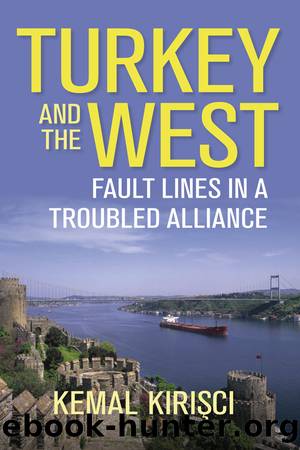
Turkey and the West: Fault Lines in a Troubled Alliance by Kemal Kirişçi
Author:Kemal Kirişçi [Kirişçi, Kemal]
Language: eng
Format: epub
Tags: International Relations, General, Middle Eastern, Political Science, World, Geopolitics, Security (National & International)
ISBN: 9780815730019
Google: LNQBDgAAQBAJ
Goodreads: 55825947
Publisher: Brookings Institution Press
Published: 2017-12-12T00:00:00+00:00
CHAPTER EIGHT
Turkeyâs Future in the Transatlantic Alliance
Three Scenarios
GREAT UNCERTAINTY FACES TURKEY. Its Western vocation seems to be in hiatus, and its place in the transatlantic alliance is weakening. This is occurring in parallel with the uncertainty that currently engulfs the international liberal order. It is not clear whether present and future U.S. administrations will remain committed to safeguarding the pillars of this orderâfree trade, common defense under NATO, respect for territorial integrity, the promotion of democratic values, and a host of other norms. It is also not clear how the European Union will manage the unending arrival of migrants and refugees, adjust to the challenges of Brexit, or negotiate rising populist and nationalist sentiments in its member states. On the borders of the EU, Russiaâs territorial ambitions will be difficult to check. There are also many challenges emanating from the turmoil in the Middle East. Indeed, the postâWorld War II international order put in place by the United States and its transatlantic allies now increasingly appears to be more and more âout of order.â1
The question of where Turkey will stand and what it will do to protect and support this order will be critical. So far, Turkey has not stepped forth as a stalwart ally. Its recent trajectory has not been promising: from its high point of being touted as a model of democracy and economic stability for the region, Turkey has sunk into an abyss of instability. The hope that it would succeed in marrying Islam with liberal democratic principles has long been dashed. The fault lines between Turkey and the West have been accentuated by a poorly thought-out U.S. policy in the region, especially with respect to Syria and Iraq; Turkeyâs entrenched suspicion of Western agendas and its belief that it is basically trying to operate in a friendless world; and Europeâs persistent othering of Turkey. Nonetheless, Turkey formed an important element of the transatlantic alliance in the past, and securing its anchor should be a matter of high priority to Europe and the United States. In this regard, the categorical observation by retired U.S. ambassador James F. JeffreyââWe could not have won the Cold War, had Turkey gone under or even better [remained] neutralâitâs that simple. And Turkey could not have remained a sovereign, independent state, had we not supported it in the beginning of the 1940s. And in the postâCold War mess ⦠short of Colombia, North Korea and the South China Sea, almost all of our conflicts, Georgia, Ukraine, Bosnia, Kosovo, Iran nukes, Syria, Gaza ⦠they all involved Turkey and we could not have done the things we did had Turkey been uncooperative or opposed to itâitâs that simpleââis very revealing and still valid.2 It would not be wrong to claim that todayâs international disorder would perhaps be less of a disorder without the tug of war between a disillusioned and skeptical Turkey and a Western alliance that has largely failed to adopt policies to dispel this distrust.
MAKING A NEW TURKEY
The Gezi Park protests
Download
This site does not store any files on its server. We only index and link to content provided by other sites. Please contact the content providers to delete copyright contents if any and email us, we'll remove relevant links or contents immediately.
The Secret History by Donna Tartt(19085)
The Social Justice Warrior Handbook by Lisa De Pasquale(12190)
Thirteen Reasons Why by Jay Asher(8909)
This Is How You Lose Her by Junot Diaz(6885)
Weapons of Math Destruction by Cathy O'Neil(6279)
Zero to One by Peter Thiel(5801)
Beartown by Fredrik Backman(5751)
The Myth of the Strong Leader by Archie Brown(5507)
The Fire Next Time by James Baldwin(5442)
How Democracies Die by Steven Levitsky & Daniel Ziblatt(5218)
Promise Me, Dad by Joe Biden(5153)
Stone's Rules by Roger Stone(5087)
A Higher Loyalty: Truth, Lies, and Leadership by James Comey(4960)
100 Deadly Skills by Clint Emerson(4924)
Rise and Kill First by Ronen Bergman(4788)
Secrecy World by Jake Bernstein(4752)
The David Icke Guide to the Global Conspiracy (and how to end it) by David Icke(4717)
The Farm by Tom Rob Smith(4507)
The Doomsday Machine by Daniel Ellsberg(4490)
